
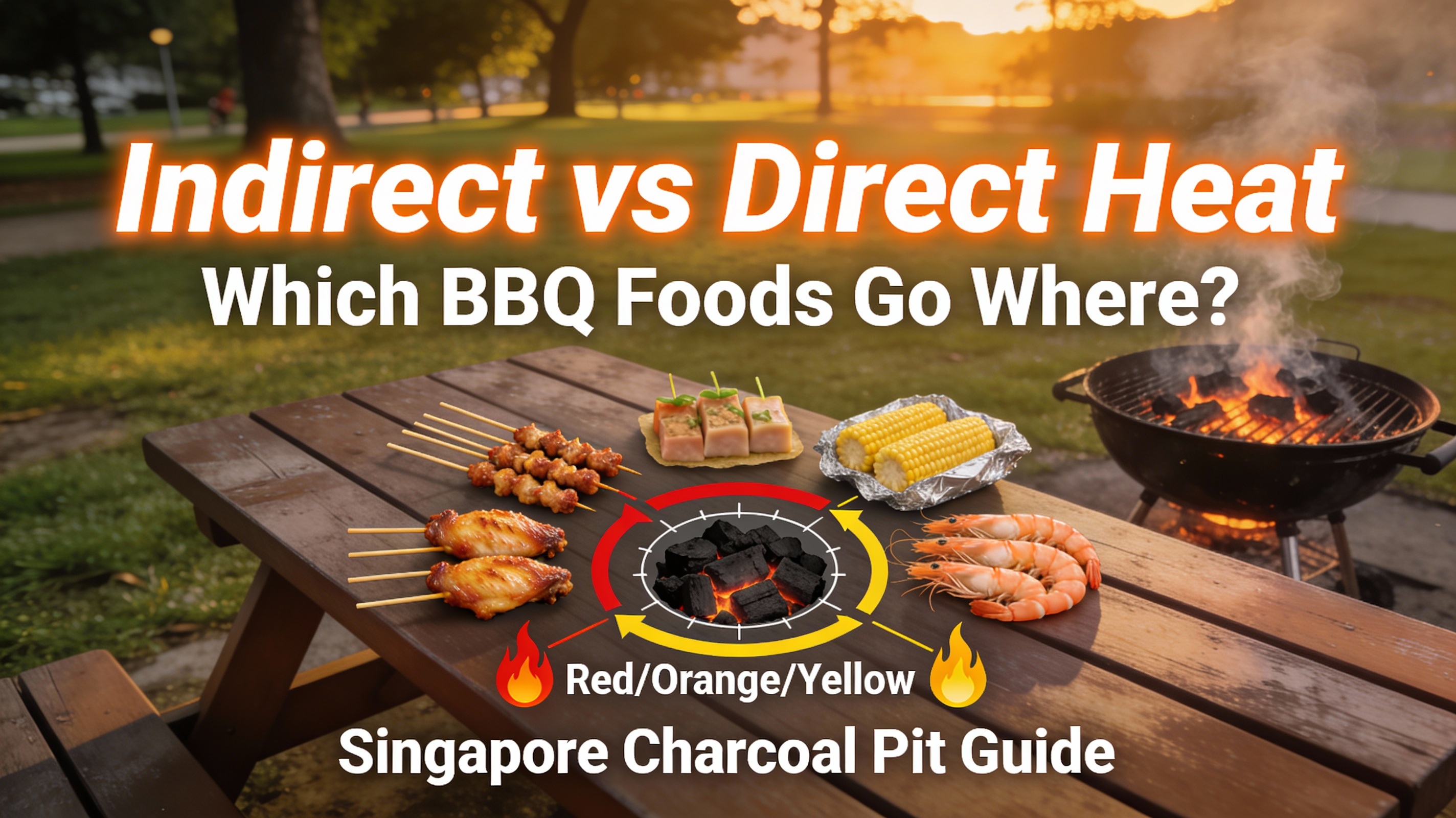
Ever grilled chicken that looks perfect outside but is still pink inside, or otah that turns rubbery instead of soft and fragrant? The secret to a great Singapore BBQ isn’t luck — it’s understanding indirect vs direct heat BBQ and how to use charcoal pit heat zones correctly.
Once you master this, you can handle everything from satay and wings to seafood, vegetables and Cook-Chill dishes with confidence. This guide explains indirect vs direct heat BBQ for Singapore charcoal pits, so you always know which foods belong on each zone.
Why heat zones matter for Singapore BBQ
Most Singapore BBQs use charcoal pits at parks, HDBs, condos or chalets, and these pits do not heat evenly.
Some areas roar with heat while others are much gentler, so placing food randomly almost guarantees uneven results.
By dividing your pit into clear heat zones, you control how fast food cooks and how evenly it finishes. Thicker or raw items benefit from gentler heat at the start, while quick-cooking foods shine with short bursts of higher heat.
Important: Heat zones are guidelines, not fixed rules.
Portion size, marinade sugar content, pit temperature and wind can affect results. Use Red, Orange and Yellow zones as starting points, then move food as needed to control doneness and charring.
Indirect vs Direct Heat BBQ Explained
Direct heat means cooking food directly above the hottest charcoal. It produces fast cooking, crisp edges and strong grill marks — ideal for quick-cooking seafood, vegetables and foil parcels.
Indirect heat places food away from the main fire so it cooks through more gently. This method suits thicker or delicate items such as chicken wings, satay, lamb chops and Cook-Chill dishes.
Most experienced hosts use both methods in one pit, moving food between zones to manage browning and doneness. This keeps the BBQ calm, predictable and evenly timed. See Weber’s direct vs indirect cooking guide for visuals.
How to set up BBQ heat zones
On a typical Singapore charcoal pit, imagine three zones from centre to edge:
- Yellow Zone – High Heat / Direct: Centre, directly over the thickest bed of hot coals.
- Orange Zone – Medium Heat / Semi‑Direct: Middle ring, where the coal layer is thinner.
- Red Zone – Low Heat / Indirect: Sides and corners, where heat is gentler.
Place fast-cooking foods nearer the Yellow Zone, and thicker or delicate foods towards the Red Zone.

Pro Tip: Set up all three zones at the start so you can move food easily instead of shifting hot charcoal mid-BBQ.
Once you understand indirect vs direct heat BBQ, these zones make timing and control much easier on any Singapore charcoal pit.
Red Zone – Low Heat / Indirect (slow & gentle)

Best for items that need time to cook through while staying juicy and tender.
| Food Item | Time | Tip |
| Satay (Raw) | 5–10 min | Flip once for an even cook |
| Buffalo Chicken Wing & Drumlet | 10–15 min | Turn occasionally to prevent hot spots |
| 3‑Joint Chicken Wing | 15–20 min | Rotate slowly for even cooking |
| Chicken Yakitori Kebab | 3–5 min | Small pieces cook fast even over low heat |
| Crab Stick | 3–5 min | Use foil to stop it sticking |
| Garlic Bread | 3–5 min | Toast gently to avoid burning |
| Salmon Fish Fillet | 5–10 min | Skin-side down or foil-wrapped |
| Crispy Cuttlefish Skewer | 3–5 min | Remove once lightly crisp |
| Otah (Raw) | 5–10 min | Low heat keeps it soft and fragrant |
| Cook‑Chill Otah | 3–5 min | Reheat gently |
| Satay (Cook‑Chill) | 3–5 min | Warm through, avoid boiling sauce |
Cooking times vary with pit heat, wind and portion size. For chicken, cook until juices run clear and the thickest part feels steaming hot.
Fun Fact: Traditional satay stalls rely on gentler, steady heat — not roaring flames — for smoky, juicy sticks.
Orange Zone – Medium Heat / Semi‑Direct (moderate & even)

Ideal for medium-thickness items and pre-marinated proteins that need colour without burning.
| Food Item | Time | Tip |
| Chicken Chop | 10–15 min | Flip once halfway |
| Lamb Chop | 15–20 min | Cover loosely with foil if thick |
| Beef Steak | 15–20 min | Sear, then rest off heat |
| Honey Baby Octopus Skewer | 5–10 min | Avoid overcooking |
| Fresh Prawn | 5–10 min | Remove once just opaque |
| Mini Taiwan Chicken Sausage | 5–10 min | Turn often |
| Fish Ball | 3–5 min | Grill to light golden |
| Chicken Nugget | 3–5 min | Heat through until crisp |
| Takoyaki Ball | 3–5 min | Rotate gently |
| Cheesy Chicken Ball | 3–5 min | Watch for bursting |
| Hotdog | 5–10 min | Lightly score for browning |
| Chicken Kebab | 5–10 min | Medium heat keeps it tender |
| Golden Veggie Tofu | 5–10 min | Brown each side |
| Vegetarian Skewer Set | 5–10 min | Cooks evenly |
| Vegetarian Meatball | 5–10 min | Heat until hot centre |
| Premium Cup Otah (Raw) | 10–15 min | Sets without burning |
Medium heat is forgiving for most marinated meats, giving good char without drying them out.
Yellow Zone – High Heat / Direct (hot & fast)

Your power zone for fast-cooking seafood, vegetables and foil parcels.
| Food Item | Time | Tip |
| Half Shell Mussel with Cheese | 8–10 min | High heat melts cheese |
| Fish Fillet (Sambal) | 8–10 min | Keep in foil to retain moisture |
| Sotong Ring (Sambal) | 8–10 min | Turn halfway |
| Cauliflower with Olive Oil | 8–10 min | Lightly char edges |
| Broccoli with Olive Oil | 8–10 min | Remove while bright |
| Holland Potato in Foil | 15–20 min | Check softness |
| Sweet Corn in Foil | 15–20 min | Rotate once |
| Corn Kernel in Foil Cup | 8–10 min | Stir midway |
| Sweet Potato in Foil | 20–30 min | Cook until very soft |
| Staple Foods (Cook-Chill) | 5–10 min | Keep covered |
| Lasagna (Cook‑Chill) | 5–10 min | Foil on until bubbling |
For Cook-Chill trays, start briefly in the Yellow Zone to activate heat, then shift to Orange or Red Zones to keep warm without drying.
Pit Placement Quick Reference
Think of your pit as a heat gradient:
- Yellow Zone (Direct): Fast searing, quick cooking
- Orange Zone (Medium): Balanced cooking for marinated items
- Red Zone (Indirect): Gentle cooking, reheating and holding warm
As charcoal burns down, food naturally moves Yellow → Orange → Red, making timing easier when the grill is crowded.

Beginner‑friendly BBQ tips for Singapore hosts
These habits prevent burnt marinades, raw centres and last-minute panic.
- Think in zones, not exact positions:
- Start thick or raw items further from the fire, then move closer to finish
- Use foil trays or parcels for small or delicate items
- Rotate food instead of flipping constantly
- If something burns, slide it one zone away — never pour water on charcoal
Pro Tip: If something keeps burning, do not pour water on the fire—just slide it one zone further from the coals and let the heat stabilise.
Common heat‑control mistakes (and how to fix them)
Burnt outside, raw inside:
→ Move to Red Zone and cook slower; next time start further from heat.
Small foods falling through the mesh:
→ Use foil trays, skewers or a grill basket.
Overcooking pre‑marinated items:
→ Use Orange Zone, not full Yellow heat; let residual heat finish cooking.
Vegetables soggy or burnt:
→ Oil lightly and grill briefly over Yellow; keep corn and potatoes in foil.
With these fixes, you can adjust on the fly instead of panicking when the first batch goes wrong.
Why Choose BBQ Wholesale Centre
Heat-zone grilling works best when ingredients are prepared specifically for charcoal pits. From an NEA-certified facility, BBQ Wholesale Centre produces marinated meats, seafood, otah, vegetables and Cook-Chill dishes designed to cook reliably across Red, Orange and Yellow heat zones.
The range is fully halal-friendly, suitable for different group sizes, and available via curated packages or flexible à la carte options with islandwide delivery. With quality ingredients and clear heat-zone planning, hosting a Singapore BBQ becomes smoother and more enjoyable.
Hosts can:
- Choose fuss-free BBQ packages for different group sizes.
- Customise spreads with skewers, wings, chops, seafood and carbs from à la carte menu.
- Stretch budgets with bundle deals and seasonal promotions.
- Enjoy delivery to homes, condos, chalets and park BBQ pits, with transparent slots and fees on the delivery page.
Learn more about the brand on the about us page, or explore venue guides and planning checklists on the BBQ tips blog.
Apply the same heat-zone method when following our sweet corn grilling guide, then use the complete Singapore BBQ checklist for equipment and timing.
FAQ
What is the difference between indirect vs direct heat BBQ?
Direct heat cooks food above the hottest coals for fast searing, while indirect heat cooks food beside or away from the fire for gentler, even cooking.
Which foods should I cook on indirect heat?
Chicken wings, drumlets, satay, lamb chops and Cook-Chill lasagna benefit from starting in the Red Zone.
What foods are best for high direct heat?
Seafood, vegetables and foil-wrapped items like corn and potatoes suit the Yellow Zone.
How do I create heat zones on a Singapore charcoal pit?
Pile more charcoal in the centre, spread a thinner layer around it, and leave the sides with minimal coals.
Can beginners manage three heat zones easily?
Yes. Remember: thick meats start in Red, marinated chops in Orange, quick seafood and veg in Yellow.
How can BBQ Wholesale Centre help with heat‑zone grilling?
Many marinated meats, skewers, seafood and Cook-Chill dishes are designed for charcoal pits with forgiving cook times that match Red, Orange and Yellow zones.
Where can I learn more BBQ tips for Singapore?
Visit the BBQ Wholesale Centre tips blog for venue guides, checklists and practical hosting advice.


